
Walking guides
Waterproof walking footwear: fit, grip and care
How to check walking footwear for a comfortable fit, suitable grip and wet-weather use, with practical care advice and clear winter limits.
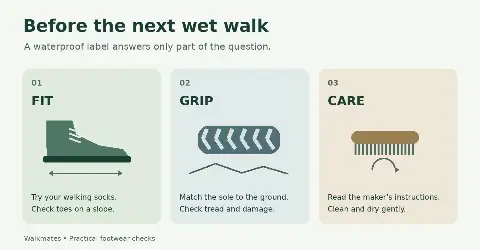
You can buy a waterproof boot that rubs your heel, a comfortable shoe that struggles in mud, or a well-fitting pair that stays damp because it never quite dries between walks. The waterproof label settles only one part of the choice.
Start with the ground you expect to walk on and how the footwear fits your feet. Then look at how it handles water and what it needs after a wet day. There is no need to buy the heaviest pair on the shelf for a stroll on maintained paths.
Try the fit while moving
Take the socks you normally walk in, plus your usual insoles or orthotics if you use them. Try both shoes, lace them properly and spend time walking around. A late-afternoon fitting can be useful because feet may swell during the day.
Check more than the number on the box:
- At the toes: there should be space to move them, without the front or sides pressing. Length, width and depth all matter.
- At the heel: aim for a secure, comfortable hold. Notice repeated lifting or rubbing as you walk.
- On a slope or steps: check whether your foot slides forward. Toes hitting the end on a shop’s test ramp are a reason to try a different fit, not something to ignore because the boot looks right.
- Around the foot: pay attention to pressure from seams, lacing and the shape of the upper.
Try a different size or model rather than relying on a universal “go up one size” rule. Before taking a new pair outdoors, wear it around the house within the seller’s return conditions. A long first outing is a poor place to discover a pressure point.
Decide what you need from waterproofing
A waterproof lining can be useful through wet grass, puddles and prolonged rain. More ventilated footwear may be a better trade-off for a warm, dry outing. Waterproof membranes can reduce breathability compared with ventilating mesh, so wet-weather protection does not promise sweat-free feet.
The opening still matters. Water can enter over the top of a waterproof shoe or boot. A higher collar changes the height of that opening; it does not turn the footwear into a sealed container. Do not use the waterproof label as a reason to wade through an uncertain crossing.
There are also two different things to watch during care. Water beading on the outside shows surface repellency. The waterproof lining, where fitted, is a separate part of the construction. If the outer fabric begins soaking up water, the maker may recommend cleaning and a compatible reproofing treatment. That is not the same as repairing damage to the lining.
If feet are getting wet repeatedly, check where and when it happens rather than immediately buying a spray. Water entering at the collar, perspiration, worn materials and a damaged lining need different responses. Ask the manufacturer or retailer about a suspected fault.
Match the sole to the ground
Look underneath the pair you already own before deciding whether you need another. Is mud packed between the tread? Are the lugs badly worn? Is the sole separating or visibly damaged?
Tread pattern and the sole’s material both affect grip. Wider spaces between lugs can help mud clear, but a sole that works well on soft ground is not automatically dependable on smooth wet surfaces. Water, mud and other material underfoot change the conditions again.
A useful way to plan is to consider the least forgiving section of the walk:
- Mostly maintained paths: choose a comfortable pair suited to the actual surface and forecast. Heavy boots are not an automatic requirement.
- Muddy field or woodland sections: look at the tread’s condition and how readily it clears mud. Keep an alternative route in mind if the ground is worse than expected.
- Smooth wet rock, timber or leaf-covered paths: do not treat a grippy-looking sole as permission to ignore the surface. Choose your footing carefully and avoid committing to a section you cannot manage confidently.
- Ice or hard snow: reassess the outing as a winter-conditions problem. Waterproofing and ordinary walking tread do not resolve it.
Lightweight traction devices have limits too. Mountaineering Scotland distinguishes suitable low-angle icy paths from steep or technical ground where a slip could have serious consequences. On steep or technical winter terrain, or where a slip could have serious consequences, microspikes are not a substitute for appropriate crampons, compatible boots and winter skills. Its winter traction guidance is a useful starting point if your planned walk crosses that boundary.
Clean them before the next walk
Leave time for drying, especially if you walk on consecutive days. The simple routine is to remove loose mud and grit, clean as directed, and let the footwear dry naturally away from direct heat. Remove laces and removable insoles where the care instructions recommend it.
Check the instructions for the exact materials. Leather, suede and fabric can need different products and treatment conditions. Some products go onto damp footwear; others need a dry surface. Do not assume the wax, household detergent or spray that suits one pair is right for another.
For membrane-lined footwear, start with the boot maker’s instructions and the lining maker’s guidance. GORE-TEX’s footwear care page explains its cleaning, drying and water-repellency advice, including the need to follow the footwear manufacturer’s directions.
Reproofing may help restore the upper’s water repellency when that treatment is appropriate. It cannot replace missing tread or mend a separating sole. Have damage assessed rather than trying to solve every problem with another coating.
The check by the door
Before leaving, put on the pair with your walking socks and ask whether it is comfortable, in sound condition and suitable for the route’s ground and weather. If one answer is doubtful, change the footwear or change the walk.
For the rest of your kit, see what to pack for a day walk. If persistent rain is the bigger concern, planning a wet-weather walk looks at the route and return journey as well as what you wear.