
Walking guides
Dog walks around fireworks: choosing the time and route
Plan dog walks around fireworks with earlier timings, a familiar return route, practical lead checks and a separate plan for necessary toilet breaks.
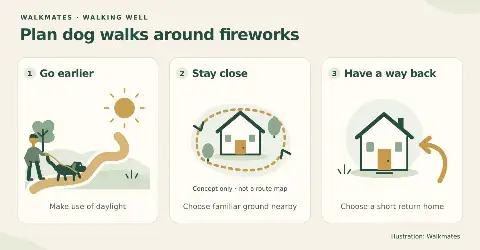
Fireworks can turn an ordinary evening dog walk into a difficult outing. Around Bonfire Night, New Year and other celebrations, plan the walk around your dog’s comfort and the way home. An earlier start, a familiar route and a realistic fallback are more useful than trying to find somewhere guaranteed to be silent.
Daylight reduces the chance of meeting fireworks, but it does not remove it. Displays can take place on several evenings, and private fireworks will not all appear on an event calendar. Keep checking beyond the main celebration date.
Decide which walk fits today
Use these three choices before putting your boots on. They are practical planning options, not a fixed exercise prescription for every dog.
- Keep the usual suitable walk, but move it earlier. This can work when your dog is comfortable, the route is appropriate and you can get home in daylight before expected fireworks. Leave room for sniffing and ordinary stops rather than rushing to beat a display time.
- Choose the familiar, easy-return option. If time is tight or you are unsure about local events, pick an outing you can shorten without improvising a new route. A nearby out-and-back may give you more flexibility than a loop whose far side commits you to another hour.
- Postpone the recreational walk. If fireworks have started, your dog is frightened or you cannot find an appropriate outing, do not force them outside to complete a mileage target. Necessary toilet breaks need their own brief, careful plan.
For a dog already worried by fireworks, ask your vet for advice tailored to them. A different path or an earlier departure may help with planning, but neither is treatment for a noise fear.
Check the local picture, not just the display time
Look at the current notices from the venue, council or land manager for the area you intend to use. Check the year, date and actual location: an old event page or a neighbouring village’s listing can look convincing in a search result.
Read any information about access, setup, road closures and gate times as well as the advertised start. A park used for a display may not be a useful walking option that day, even while the sky is light. Do not assume that a cancelled public event means there will be no fireworks nearby.
Then check daylight and the ordinary conditions for the route. Darkness, mud, traffic or a closed gate still matter when your main concern is noise. Our guide to planning a walk within daylight helps you work backwards from a sensible finish time.
Treat local information as a reason to adjust the plan, not as a promise. There is no reliable quiet radius around a display, and a gap between bangs is not an all-clear.
Choose a route you can leave without a puzzle
For an uncertain evening, favour ground you and your dog already know. Before setting off, identify the point at which you will turn back and the legitimate route home. A shorter alternative is useful only if you know where it goes and are allowed to use it.
Consider the return as carefully as the outward leg:
- Can you turn around at several points, or does the route depend on completing a long circuit?
- Would a frightened dog have to negotiate a busy road, awkward stile or narrow section close to livestock?
- Does the way back pass the venue you are trying to avoid?
- If you drive somewhere, how will you get back to the vehicle without a long exposed return?
A remote car park or an unfamiliar wood is not automatically a quieter or better choice. Moving farther from home can leave you with fewer familiar options if your dog becomes unsettled. Save the exploratory extension for another outing; you do not have to make every walk a new route.
Keep the countryside rules in the plan
A field that looks peaceful is not a shortcut to use without checking access. Follow local signs, keep your dog under control and avoid livestock where possible. Check the relevant guidance for England and Wales, Scotland or Northern Ireland, rather than assuming the same access rules apply everywhere.
Plan an on-lead walk around fireworks, including for a dog with good recall. There is an important emergency exception: countryside guidance advises releasing your dog if cattle threaten you, rather than putting yourself at risk by holding on. Avoiding such an encounter is another reason to choose your route carefully. Bag and bin dog mess, or take it home if there is no bin.
Check the dog’s kit before the door opens
Check the condition and fit of the lead, collar and any harness. A well-fitting harness may help a dog prone to backing out of a collar, but no piece of equipment is an escape-proof guarantee. The Animal Trust guide to preventing fireworks-related escapes explains these checks in more detail.
Make sure your dog’s identification and microchip contact details are current. Take the normal supplies for that dog and outing, including bags and water where needed. Do not add distance because you have packed for it: the plan should still suit the dog and today’s conditions.
If fireworks start while you are out
Keep calm and head home if it is safe to do so. Use the familiar, permitted return you planned rather than cutting through unknown ground to get away from a sound. Do not take your dog towards a display to investigate or to get them used to it.
Watch your dog as well as the sky. Trembling, a tucked tail, hiding, restlessness or attempts to escape can be signs of distress. Panting can also have other causes, so do not diagnose a problem from one sign alone. If you are concerned about your dog’s wellbeing, contact your vet.
Do not scold or punish a frightened dog. Once home, help them settle in a secure, familiar space and offer comfort if they seek it. Dogs Trust’s fireworks advice covers recognising fear and supporting a dog indoors.
Keep toilet breaks separate from the evening walk
A necessary toilet trip is not the same as restarting the recreational walk. Use a secure garden where possible, go with your dog and use a lead if there is a risk of escape. Without a suitable garden, plan the shortest appropriate accompanied trip, ideally during a lull, while remembering that fireworks can restart. Do not force a frightened dog outside; ask your vet for help if you cannot meet their needs without distress.
Before the next outing, revise the plan using what actually happened. If an apparently quiet route was noisy, choose differently next time. If your dog was comfortable on an earlier walk, keep that useful routine. The aim is an outing that meets your dog’s needs with room to change your mind.